Contents
What you’ll take away
- The requirement to have a French website is not new. What changed on 1 June 2025 was mostly signage and trademarks, plus a lot more attention on the topic.
- According to legal analysis, intending to make your products or services available to Quebec can be enough to be covered. A transaction isn’t required.
- The law asks for a French version at least as accessible and prominent as the others. That is also roughly what Google needs to index it.
- The most common failure is technical, not legal: an automatic language or IP redirect that hides the French version from crawlers.
- A literal translation may comply, but it rarely ranks. Quebec French has its own search vocabulary, and Quebec is a market of close to nine million people.
Before we start
I’m an SEO consultant, not a lawyer. This article summarizes public legal sources and draws technical conclusions from them. It is not legal advice and doesn’t replace guidance from a lawyer or from the Office québécois de la langue française (OQLF) for your situation.
1. What the law requires, and what didn’t change
Quebec’s Charter of the French Language has long required commercial publications to be in French: catalogues, brochures, flyers, directories and other commercial documents available to the public. Business websites fall under the same rule, as does commercial content on social media.1 Other languages are allowed, on one condition: the French version must be at least as accessible and prominent as the version in another language.1
The 1 June 2025 date got a lot of coverage outside Quebec. It mainly concerned two things: public signage visible from outside a business, where French must now be markedly predominant, and trademarks, where generic or descriptive terms must now follow the rule that French comes first.2 For websites, McCarthy Tétrault puts it plainly: Bill 96 did not significantly change website availability requirements. A site that isn’t compliant today wasn’t compliant before either.2
What changed is the risk. Media coverage in 2025 increased complaints, and fines were raised in 2022. For a business, they range from $3,000 to $30,000 for a first offence, $6,000 to $60,000 for a second, and $9,000 to $90,000 after that. Directors can also be held personally liable.3 In practice, the OQLF generally starts by asking the business to comply within a set period; prosecution follows when that request is ignored.4
2. Does it apply to companies outside Quebec?
This is the question I hear most from Ontario and Western Canadian clients. According to Fasken’s analysis, a transaction isn’t required: it can be enough to intend to make goods or services available to the Quebec market. A company claiming it doesn’t serve Quebec customers may have to show it to the OQLF.3
In concrete terms, a Toronto online store that ships to Montréal, or a Vancouver SaaS company that accepts Quebec customers, should take the question seriously and check its position with counsel. It is also, as we’ll see, a commercial opportunity most of them miss.
3. “At least as accessible”: what it means on a website
The law doesn’t come with a technical checklist. But a cautious reading of “at least as accessible and prominent” translates naturally into design requirements. Here they are, in the order I find them in audits:
- Missing pages. The home page and services are translated, but not the blog, product pages, FAQ, terms of sale or downloadable PDFs.
- A two-speed French site. The English version gets new launches, promotions and updates first; the French version follows weeks later, if at all.
- A journey that falls back to English. The visitor starts in French, then the cart, form, confirmation email or customer portal appears in English.
- A hard-to-find language switcher, or one that always sends people to the other language’s home page instead of the equivalent page.
Each of these is a potential compliance issue. Each is also an SEO problem: missing pages can’t rank, lagging pages lose freshness, and a journey that switches language hurts conversion.
4. SEO trap #1: automatic redirects
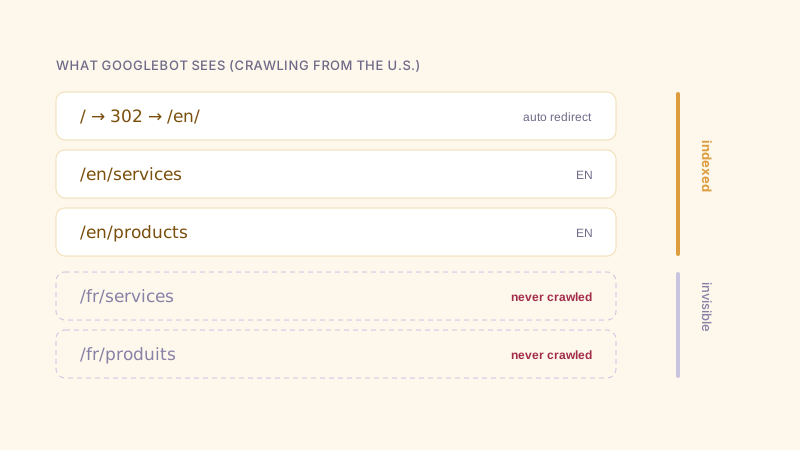
This is the issue I find most often on bilingual Canadian sites, and the most costly. The site detects the browser language or the visitor’s IP address and automatically sends them to “their” version.
For a human in Quebec, it seems to work. For Google, it’s a black hole. Google’s documentation is explicit: Googlebot usually crawls from the United States and sends requests without an Accept-Language header. Google therefore recommends avoiding automatic redirects from one language version to another, and offering visible links to choose a language instead.5 A common result: the crawler is sent to the English version every time, and part of the French site is never crawled.
The two-minute test
In Search Console, run the URL Inspection tool on an important French page, then test the live URL. If the rendered page is in English, or the tool reports a redirect, you’ve found the problem. Then check the indexing report: how many of your French URLs are actually indexed?
The fix satisfies both the law and Google: separate URLs for each language, a visible switcher that leads to the equivalent page, and optionally a banner that suggests a language without ever forcing a redirect.
5. Translation is not ranking
A French version that faithfully mirrors your English site may satisfy the Charter. It still rarely ranks well, because Quebec searchers don’t use a translator’s words. A few examples that come up repeatedly in my keyword research:
| English | Literal or European French | What Quebecers often type |
|---|---|---|
| get a quote | demander un devis | demander une soumission |
| e-mail, mail | courriel | |
| weekend | week-end | fin de semaine |
| cell phone | téléphone portable | cellulaire |
| go shopping | faire du shopping | magasiner |
| parking | parking | stationnement |
These gaps aren’t universal and vary by industry. Don’t rely on my table or on your translator’s instinct: check Google Keyword Planner filtered on French and the province of Quebec, and look at what already ranks on Google.ca in French. That is the difference between a translation and a French site that earns its keep.
The same logic applies to structure. An English page targeting one broad term can map, in French, to two distinct intents that deserve two pages. That’s why I build each language on its own keyword research rather than translating a sitemap.
6. The technical checklist
Once the content exists, here is what lets Google (and AI engines) understand that you have two equivalent versions, and serve the right one to each searcher:
- Separate URLs per language, such as
/fr/and/en/, or two distinct files. Never two languages on one URL based on a session setting. - Reciprocal
hreflangtags:fr-CA,en-CAand anx-default, declared on every page and pointing to the exact equivalent.6 - A self-referencing canonical, never pointing to the other language.
- Everything Google reads, in French: title tag, meta description, image alt text, URL slug, breadcrumbs and menus.
- Structured data in French, with
inLanguageset tofr-CA. - An XML sitemap listing both versions, ideally with their
hreflangalternates. - The extras: a French product feed in Merchant Center if you sell online, and a Google Business Profile description and posts in French if you have a Quebec location.
7. What about machine translation?
Translation tools have become excellent, and I use them myself as a starting point. The risk isn’t the tool, it’s publishing at scale without review. Google’s spam policies list automated translation among the transformations that can count as scaled content abuse when it’s used to generate many pages that add little value.7
My approach is simple: machine-assisted translation for volume, review by someone who knows Quebec French, and a full rewrite for the pages that need to rank (home, services, categories, pillar pages). Legal pages can wait for the second pass; your sales pages can’t.
8. The AI layer: AI Mode and ChatGPT in French
Google’s AI Mode launched in Canada in English in August 2025, and in French in October 2025.8 When someone asks a question in French, the generated answer looks for French-language sources. If your French version is thin, incomplete or hidden behind a redirect, the engine cites someone else, often a European site or a directory.
I covered in another article why generative engines cite foreign sources for Canadian queries. The short version: a complete French version, tied to your English version through hreflang and a shared entity in your structured data, is one of the easiest signals to fix.
9. A 20-minute audit
- Open your site in a private window with the browser set to English. Can you reach the French version of every page in one click?
- Run three important French pages through Search Console’s URL Inspection. Are they indexed, and is the rendered page actually in French?
- Compare the number of indexed pages in French and in English. A large gap points to missing or invisible pages.
- Check the
hreflangand canonical tags on those three pages (right-click, view source). - Go through the full journey in French: form, cart, confirmation email. Note every place English reappears.
- Ask ChatGPT and Google AI Mode, in French, the question a Quebec customer would type to find a business like yours. Who gets cited?
If two of these six checks fail, your French version is probably costing you customers, before compliance even enters the conversation.
Questions I get asked
My company is in Ontario. Does my website need to be in French?
If you offer your products or services to the Quebec market, probably. According to Fasken’s analysis, intending to make goods or services available in Quebec can be enough, without a transaction. Confirm your position with a lawyer or the OQLF.
Did Bill 96 create the requirement for a French website?
No. Commercial publications, including websites, already had to be in French. What changed on 1 June 2025 concerns mostly outdoor signage and trademarks. The topic simply became more visible, and fines increased in 2022.
Can I put French and English on the same page?
It’s possible, but rarely a good idea for SEO. A bilingual page ranks poorly in both languages because Google has to guess which language to show it for. Two separate URLs connected with hreflang perform much better.
Should I automatically redirect Quebec visitors to the French version?
No. Google recommends avoiding automatic redirects based on language or location, because its crawler mostly crawls from the United States and may never see some versions. Offer a visible language switcher or a banner that suggests the language instead.
Is machine translation acceptable?
As a starting point, yes. Published at scale without review, it risks low-quality content that Google can treat as scaled content abuse. Have it reviewed by someone who knows Quebec French, and rewrite the pages that need to rank.
How long does a new French version take to rank?
Technical fixes (redirects, hreflang, indexing) often show results within a few weeks. New French pages typically take three to six months to rank on competitive queries.
Sources
- Fasken, Réforme de la Charte de la langue française (in French): commercial publications, websites and social media; French version “at least as accessible and prominent”. fasken.com
- McCarthy Tétrault, Bill 96 and 1 June 2025 French requirements: misconceptions (in French). mccarthy.ca
- Fasken, FAQ Bill 96: doing business in Quebec (in French): websites, intent to serve the Quebec market (s. 50.2 and 52), fines (s. 205 to 207). fasken.com
- Éducaloi, Language Legislation: Does Your Website Comply? educaloi.qc.ca
- Google Search Central, Managing multi-regional and multilingual sites. developers.google.com
- Google Search Central, Tell Google about localized versions of your page. developers.google.com
- Google Search Central, Spam policies for Google web search (scaled content abuse). developers.google.com
- Google Canada, Introducing AI Mode in Canada (21 August 2025) and Le Mode IA est maintenant disponible en français (14 October 2025). blog.google
This article is not legal advice. For your situation, consult a lawyer or the Office québécois de la langue française.

Hicham Souilmi
SEO and AI search (GEO) consultant · Canada · 20 years in digital
I build bilingual sites that rank in both languages and get cited by Google and AI engines. Each language gets its own keyword research, never a straight translation.